
Sloped lots are practically a given in the Hill Country, and most homeowners eventually hit the same question: what’s going to hold that grade in place? A limestone retaining wall, a reinforced double CMU wall, and a steel retaining wall can all solve that problem, but each does it differently.
One leans into the rugged, organic look of the region. One leans into engineered strength with a finish you choose. One leans into a slim, modern profile built for serious grade. Choosing between them comes down to your soil, your slope, your style, and how much you want to spend.
Comparing Your Three Main Options
When it comes to retaining walls, most Austin homeowners end up choosing between three paths: natural limestone, reinforced double CMU, or steel. All three can hold back a slope safely when built correctly, so the real differences come down to appearance, cost, installation time, and how each system fits the character of your home. Here is what actually separates them, so you can pick the one that fits your property.
Natural Limestone Retaining Walls
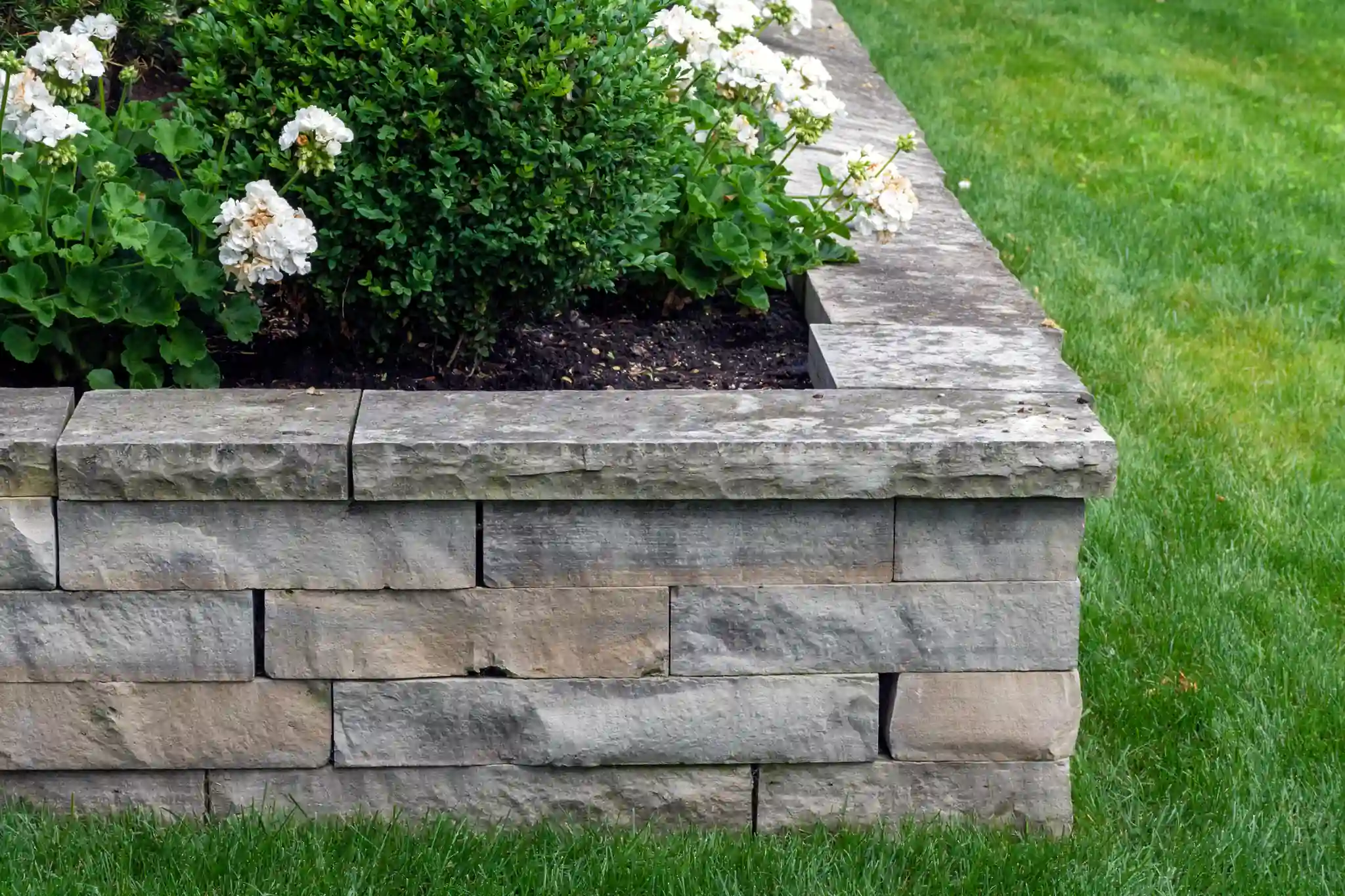
Limestone is the material most people picture when they think of a classic Austin backyard. Quarried right here in Central Texas, it means the color and texture of a limestone wall tend to match the land around it instead of looking like something dropped in from a catalog. Every wall we build includes a properly engineered footing and drainage system behind it, so the wall performs structurally, not just visually. Limestone is also a mainstay of our broader stonework and masonry work across Austin properties.
A few things make natural limestone a strong choice for Austin properties:
- It blends with the landscape. Because so much of the region is already built on limestone, a limestone wall often looks like it grew out of the hillside rather than being added to it.
- It holds up to Central Texas weather. Freeze-thaw cycles are mild here, but our clay-heavy soils expand and contract with moisture swings. Properly built limestone walls, backed by an engineered footing and drainage system, handle that movement well.
- Every wall is one of a kind. No two stones are identical, so the finished wall has texture and variation that manufactured materials cannot fully replicate.
- It ages naturally into the landscape. Buyers touring Hill Country homes often expect natural stone, and a limestone retaining wall in Austin neighborhoods with a lot of exposed rock tends to look more established the longer it’s in the ground.
The tradeoff is labor. Stonework takes a skilled mason, and the installation timeline is longer than a CMU or steel wall. It is also typically the more expensive option upfront, though many homeowners consider that a fair trade for the look and longevity.
Reinforced Double CMU Retaining Walls
A reinforced double CMU retaining wall is built from an engineered block core: steel-reinforced, grout-filled cells, and a poured concrete footing, finished with a limestone veneer, stucco, or other facade of your choosing. That combination gives you structural consistency underneath and design flexibility on the surface, which is what sets it apart from a basic block wall. This is the system behind most of our retaining wall installations across Austin and the surrounding Hill Country.
Reinforced double CMU walls have their own set of advantages:
- Faster installation than hand-set stone. Because the core assembly is uniform and modular, crews can build a double CMU wall more quickly than a comparable all-stone wall.
- Consistent structural performance. The steel reinforcement and grout-filled cells are engineered to precise specifications, which makes it easier to calculate load capacity for taller or more demanding walls.
- Facade flexibility. Because the structural core and the finish are separate, you can dress the wall in limestone veneer for a natural look, stucco for a cleaner modern look, or another facade entirely, without changing the engineering underneath.
- Strong cost-to-performance balance. Material and labor costs generally land below all-stone construction, which matters on larger retaining projects, while still giving you a stone-faced result if that’s the look you want.
The tradeoff here is that the facade, not the core, is doing the aesthetic work. If your priority is a fully organic, hand-set look throughout the wall, natural limestone still reads differently than a veneer over a CMU core, even a well-finished one.
Steel Retaining Walls
A steel retaining wall uses steel sheet piling or soldier piles to hold back soil, and it is the third system we build regularly across Austin properties. Steel handles some of the toughest site conditions in the Hill Country, particularly steep grades and tight lots where a wide masonry footprint isn’t practical.
Steel retaining walls stand out for a few reasons:
- Strength on a slim profile. Steel can hold back significant lateral soil pressure without needing the footprint that a masonry wall requires, which matters on narrow side yards or steep drop-offs.
- Well suited to challenging grades. On the steepest slopes, or where soil conditions make a wide masonry footing difficult, steel is often the most practical engineered solution.
- Efficient installation. Steel sections go in faster than a comparable stone wall, which can help on time-sensitive projects.
- A modern, industrial look. Exposed steel reads as intentional and contemporary, and it pairs well with modern landscape design.
The tradeoff is aesthetic and maintenance-related. Steel has a distinctly industrial look that doesn’t suit every style of home, and it typically needs a protective coating or finish to hold up long-term against Austin’s humidity and moisture swings.
How to Decide Which Wall Is Right for You
Here is how we usually walk homeowners through the decision. If your priority is matching the natural terrain of a Hill Country lot, or you want a wall that will patina and feel more established over time, natural limestone is worth the investment. If you want that same stone look with more structural flexibility and a lower price point, a reinforced double CMU wall with a limestone veneer or stucco facade often makes more practical sense. If you’re dealing with a steep grade, a tight lot, or a more modern build, steel is worth a serious look.
Height and load also matter. Taller walls, or walls holding back a lot of soil on a steep grade, benefit from the engineered consistency of double CMU or steel construction. Shorter accent walls and garden terraces are a great place to let natural limestone shine, since the labor cost has less room to grow with the size of the project.
Soil type plays a role too. Our team evaluates drainage and soil composition on every retaining wall project before recommending a system, because a wall that looks great but traps water behind it will fail no matter what it is made of.
Why Work With a Local Hill Country Builder
Retaining walls are not a project to guess on. A wall that is not engineered for Austin’s soil and drainage conditions can shift, lean, or fail within a few years. J&L Hardscapes has built retaining walls across Austin, Bee Cave, Cedar Park, Dripping Springs, Lakeway, and the surrounding Hill Country, so we know how local soil behaves on a slope and how to design for it.
Whether you are drawn to the natural texture of limestone, the flexibility of a reinforced double CMU wall with the facade of your choice, or the engineered strength of steel, our hardscaping team can walk you through your options and help you land on the right system for your budget and your yard.
FAQ
How much does a retaining wall cost in Austin?
Cost depends on wall height, length, system, and site access. Natural limestone generally costs more per square foot than reinforced double CMU or steel, mainly due to labor.
Do retaining walls need drainage?
Yes. Every retaining wall needs proper drainage behind it to relieve water pressure, regardless of whether it is built from limestone, CMU, or steel.
Can I combine systems on the same project?
Yes. Some homeowners use a reinforced double CMU core for structural, load-bearing sections and natural limestone veneer or accents for visible, decorative areas, or pair steel on a steep section with limestone elsewhere on the property.
The Bottom Line
All three systems can produce a retaining wall that lasts for decades in Austin’s climate, as long as it is designed for your soil and built with proper drainage. The real decision comes down to what you value most: the organic, one-of-a-kind look of hand-set limestone, the flexibility and cost balance of a reinforced double CMU wall, or the engineered strength of steel on a challenging grade.
Once you know your priorities, the right system tends to become clear pretty quickly, and that is exactly the kind of conversation we like to have with homeowners before ground ever breaks. You can also calculate the cost of your desired material with our retaining wall cost calculator. Ready to figure out which wall makes sense for your property? Get in touch with J&L Hardscapes and we will walk your site with you.